Kerrand’s departure from Sokcho
Winter in SokchoYan Kerrand’s departure from Sokcho is both a practical parting and the ending of an unfinished exchange between the artist and the narrator. He tells her that he has been absorbed in his hero for too long and will return to France rather than take up more of her time; after he is gone, his empty room and the frayed sketchbook left on the desk give that decision a quiet, unresolved afterlife.
Decision to Leave
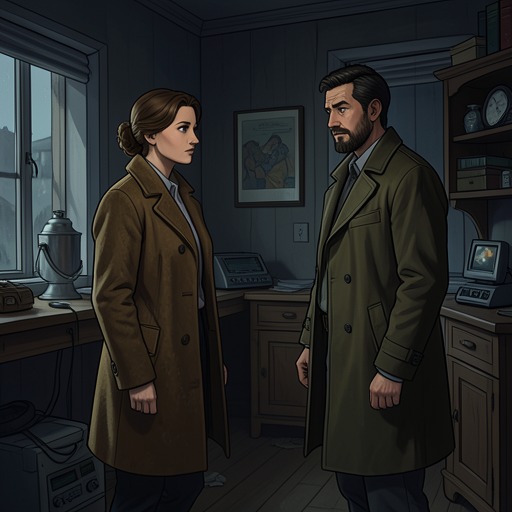
The departure begins not with a formal farewell but with Kerrand’s return to the narrator’s door. He needs to go to the supermarket again and asks whether she can translate one word for him, while making clear that she need not accompany him. The request is ordinary, but the narrator holds her breath as the encounter changes course. Kerrand eventually says that he will manage without the translation. After a pause, he tells her in French that she was right: he has been too wrapped up in his hero for far too long. He has decided to return to France and says he will not waste any more of her time. He will leave in four days.
The sequence makes his departure more than travel logistics. Kerrand connects it to his preoccupation with his work and to the narrator’s time, acknowledging both his artistic absorption and the possibility that his presence has imposed on her. He does not extend the conversation into a full explanation. He goes back to his room, and the narrator goes to bed and curls up beneath the covers. His decision is stated plainly; its emotional weight appears instead in the pause before it and in her response afterward.
The Last Encounter
On the morning of the fourth day, the narrator is sorting laundry when she finds trousers apparently forgotten by the girl with the bandages. She takes off her tights to try them on. The trousers fit loosely around her thighs but will not fasten at the waist; she pulls them off, nearly in tears, and notices a run in her tights. While looking through the washing for another pair, she sees Kerrand standing in the doorway with a bag of clothes.
The scene places her discomfort and his imminent departure in the same confined space. She tugs her sweater down to hide her legs and tells him she is sorting colours, offering to take his clothes. He sets the bag down awkwardly, then changes his mind: there is no need to wash them, because his bus leaves the next morning at ten. The practical detail confirms that the announcement has become immediate. He offers to send her a copy of the book when it is published; she tells him not to feel obliged. Their exchange recognizes a future connection through the book, but neither turns that possibility into a promise of continued closeness.
Traces of Departure
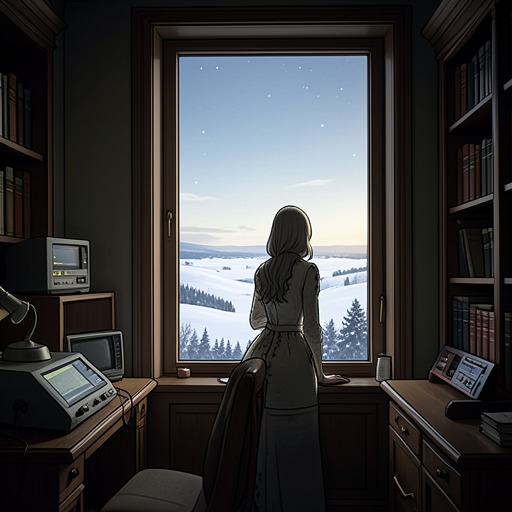
The narrator does not describe watching Kerrand board the bus. His absence is established afterward, through the traces left in the courtyard and his room. The courtyard door is open, and two fine lines of footprints cross the snow from Kerrand’s room, past the fountain and chestnut tree, to the door before disappearing into the distance. She stares at the tracks, then walks along the covered walkway to his room.
Inside, the curtains are drawn and the quilt is carefully folded on the bed. The smell of his breath remains, mingled with incense; in the mirror, a beam of light catches dust settling from the ceiling onto the desk. These details make the room feel recently occupied but already relinquished. The narrator notices the dust on the windowsill, sits carefully on the bed without wanting to wrinkle the sheets, and listens as the buzzing in her ears grows softer. The light dims and blurs the room’s contours. A fish and an ink stain at the foot of the bed remain in view, but even the stain, she thinks, will fade in time. The departure is thus rendered as an accumulation of absences rather than a witnessed farewell.
The Sketchbook Left Behind
On the desk lies Kerrand’s frayed canvas sketchbook. The narrator puts down the platter she has brought and opens it. Its first large, wordless images show his hero and a heron standing together on a winter shore, gazing toward the sea, with a snow-covered mountain behind them. The old-looking bird has one leg and silver feathers; water pours from its beak and becomes a river flowing into the ocean. The sequence retains Kerrand’s hero, but surrounds him with an image whose movement leads beyond the figure and toward the sea.
As the narrator turns the pages, the pictures become less bounded. Faceless, ageless people leave faint yellow and blue traces in wet sand; the sea spreads beyond the beach and into the sky. The depicted place seems to form as it is conceived and then dissolve, a threshold where falling snow meets sea spray. In later pages the story itself appears to fade: the bird’s eyes close, the paper becomes blue, and the man moves passively beneath winter waves. An afterimage of a woman’s shoulder, belly, breast, and lower back narrows into a stroke of ink on a thigh, ending in a long, fine scar rendered as if carved with a brush.
The notebook does not explain why Kerrand left it, and the scene does not turn it into a definitive message. Instead, its changing images complicate the departure: the hero remains, but the drawn world opens around him and finally gives prominence to a woman’s body and its marked surface. The narrator’s act of opening the book makes its unfinished story part of the parting. Kerrand has gone from the room; what remains is a sequence of images that she can look through but cannot reduce to a settled explanation.